






Key Features:
- Reproductive health in men and women in all stages of life
- Promotion of vitality, stamina, energy, and mood balance
- Bowel regularity
- Healthy endocrine gland function (thyroid, pancreas, adrenal glands, testes, ovaries)
- Collagen-based structures (bone, muscles, hair, skin, nails)
There is so much to say about Maca! The fact that one of the many names for it is "Peruvian Ginseng" gives a clue about its nature. Eaten as a traditional food for thousands of years, the Maca root has been used by traditional peoples to enhance libido and energy, as well as numerous therapeutic uses.
We have a lot of respect for Maca because it does something that is fairly rare - it supports the regeneration and optimal functioning of the endocrine system, including the pancreas, thyroid, adrenals, ovaries, and testes. It is an adaptogen, meaning that it helps the body deal with stress. Because endocrine gland balance and immune system function are so interrelated, it often notably enhances immune system functioning.
The Maca root is a hardy cruciferous vegetable cultivated in an inhospitable region of the Andean Mountains at altitudes from approximately 12,500-14,500 feet. The part of the plant used for medicinal purposes is the root. Maca is rich in essential minerals, especially selenium, calcium, magnesium, and iron, and includes fatty acids including linolenic, palmitic and oleic acids, and polysaccharides.
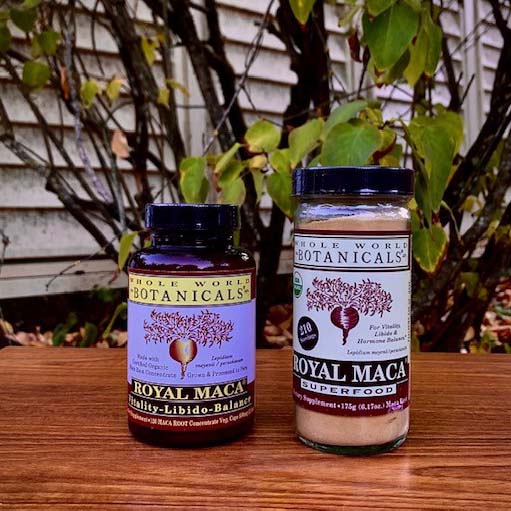
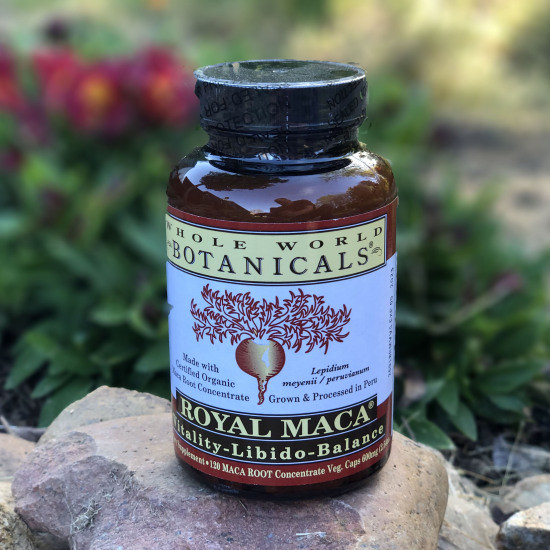
This Royal Maca superfood is available in powder and capsule form. It is the highest grade of Maca available. Make a warm tea out of it, sprinkle it on foods, mix it into smoothies; add this royal Maca root to your life, and put on your seatbelt!
6.17 oz. Royal Maca Powder
Supplement Facts
Serving Size: 1/3 tsp (833 mg)
Serving Per Container: 210
Bottle contains: 70 tsp
| Amount Per Serving | % Daily Value* | |
|---|---|---|
| Total Carb. | .55 g | <1% |
| Selenium (from maca root) | 2.49 mcg | 5.6% |
| Organic Maca Root Concentrate | 833 mg | ** |
* Percent Daily Values are based on a 2,000 calorie diet
** Daily Value Not Established
Maca root contains selenium. This is not an additive
Directions for Use: (Don't Refrigerate)
Sensitive or petite people: Start with 1/12 or 1/6 tsp. daily.
For energy & well-being: 1/4-1/3 tsp. daily.
Men over 50: 1/2-1 tsp. daily. Some may find it more effective to take 1 tsp. every other day.
Young & Perimenopausal Women: 1/3 tsp. daily. Increase to 1/2 tsp. for hot flashes.
Women with no period: 1/2 tsp. daily for 1st week. Increase by 1/2 tsp. daily per week as needed until symptoms are 80% better.
If taking HRT or estrogenic herbs, STOP for 4 weeks before starting Royal Maca to avoid an increase in hot flashes. Meanwhile to control symptoms take 1/2-1 tsp . of Royal Camu¨ 3 times per day. May be taken with progesterone-only birth control pills.
Warnings
Consult physician if pregnant or nursing. Do not use with Tamoxifen¨ or Lupron¨.
120 Capsules
Supplement Facts
Serving Size: 2 capsules
Serving Per Container: 60
| Amount Per Serving | % Daily Value | |
|---|---|---|
| Total Carb. | 79 mg | <1% |
| Selenium (from organic maca root) | 2.99 mcg | 7.9% |
| Organic Maca Root Concentrate | 1200 mg | ** |
* Percent Daily Values are based on a 2,000 calorie diet
** Daily Value Not Established
Maca root contains selenium. This is not an additive
Other Ingredients (Capsule): Plant Cellulose, Purified Water.
Directions for Use: (Don't Refrigerate)
Sensitive/petite: Take 1/2-1 cap daily.
For Immune Support: 2 caps daily.
Male Potency: Take 2-6 caps daily or every other day.
Women-Painful periods or PMS: 2 caps daily. Start at beginning of menstrual cycle.
Menopausal: Start with 3 caps daily. Increase by one cap daily each week if needed, until hot flashes & other symptoms are 80% better.
Avoid estrogen and phyto-estrogenic herbs. Can be taken with progesterone-only birth control pills. Wait 4 weeks after stopping to start Royal Maca.
Meanwhile to control symptoms take 3-5 caps of Royal Camu¨ 3 times per day.
Warnings
Consult physician if pregnant or nursing. Do not use with Tamoxifen¨ or Lupron¨.
Frequently Asked Questions
Q. Can foods that contain phytoestrogens such as soy, beans and pomegranates be eaten when also taking Royal Maca?
A. The general answer is yes. However, isoflavones of soy which is the phytoestrogenic part of the soy bean, isolated, concentrated and sold as a supplement cannot be combined with Royal Maca.Neither can bioidentical hormones, regular HRT, estrogenic vaginal suppositories or patches, nor any phytoestrogenic herbs such as black cohosh, mother wort, red clover, licorice root, etc.